Pixel Flow Level 95 Solution | Pixel Flow 95 Walkthrough
How to beat Pixel Flow Level 95: Video solution & walkthrough. The fastest way to pass Pixel Flow 95.
Is this the wrong level layout?🤔
Pixel Flow randomizes levels for different players. Don't worry, just upload a screenshot of your board, and our AI will find the correct video instantly.



Pixel Flow Level 95 Walkthrough
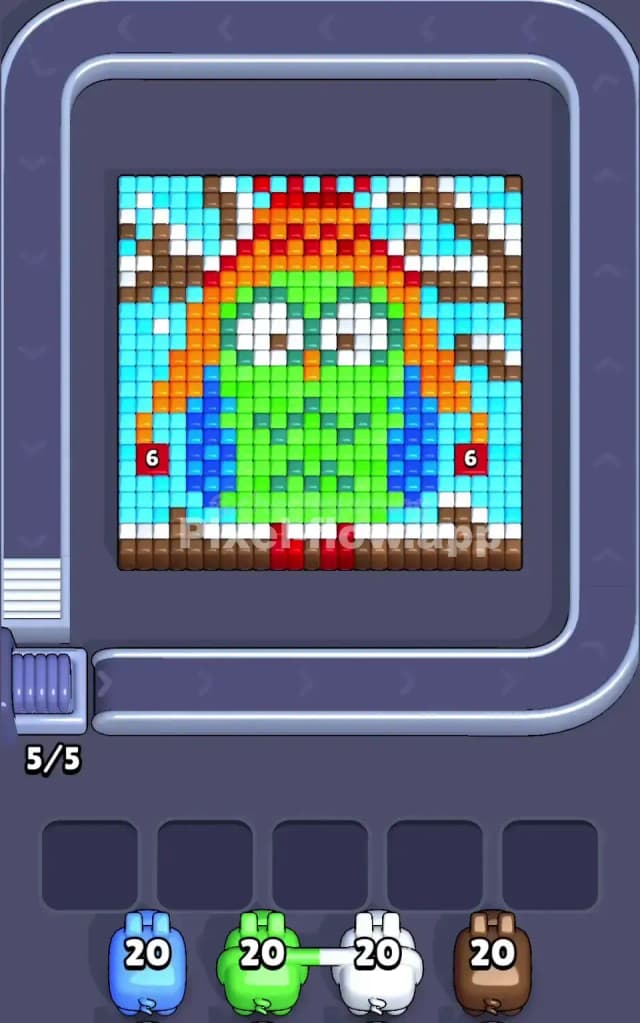
Pixel Flow 95 features a quirky green monster (or maybe an owl?) bundled up for winter. The main colors are Green (the body), Orange (the hat/hair), Light Blue (the icy background), and Dark Blue (scarf/wings). There are also accents of White (eyes/snow) and Brown (tree branches).
The rules are standard but strict: pigs shoot cubes of their matching color. If they can't shoot immediately, they clog up your waiting slots. With a dense central figure like this, slot management is key.
Is this level hard? It is very hard if you aren't careful with the background. The scattered snowflakes and branches can easily trap your pigs if you focus too much on the monster's face first.
Pixel Flow Level 95 Overview
Imagine a chilly winter scene. In the center stands a large, blocky green creature. It looks like it's wearing a thick orange beanie or has bright orange hair. Two big white eyes stare out from the green mass. To the left and right, deep blue patches suggest wings or a scarf wrapped around it.
The background is the tricky part. It’s a mix of light blue sky/ice and white snow, interrupted by horizontal brown branches.
Asymmetry Check: The board is fairly symmetrical, but the background noise (the white snow pixels and brown branches) is random. The top corners are heavy with light blue and brown, while the bottom is grounded by a solid brown floor layer. The danger lies in the White pixels scattered in the background. They are single blocks, meaning a White pig will fire one shot and then sit in your slot for a long time waiting for the next target.
Step by step solution walkthrough for Pixel Flow Level 95
First Color Zone to Erase in Pixel Flow Level 95
I strongly recommend starting with the Light Blue or Brown background elements, specifically the bottom and top edges.
Here is why: The bottom row is a solid line of Brown. A Brown pig here is highly efficient—it clears an entire row and won't clog your slots. Similarly, the Light Blue sky areas on the left and right are large, accessible chunks.
Avoid the Green Body initially. While tempting because it's big, the green is "locked" behind other layers. If you grab a Green pig too early, it might hit one or two exposed blocks and then get stuck in a slot because the rest of the green body is buried under the eyes or scarf. Clear the perimeter first to expose the core.
How to pass Pixel Flow Level 95 without power ups or boosters
The mid-game is the danger zone. At this point, you have likely cleared the icy background (Light Blue) and the floor (Brown). Now you are left with the Green monster, the Orange hat, and those tricky White eyes.
The Strategy Shift:
- Prioritize the Orange Hat: The orange section at the top is usually exposed once the sky is gone. Orange pigs typically have high ammo. Let them shred the top of the head.
- Watch the White Pigs: This is the trap. The eyes are small (only a few pixels). If you grab a White pig too early, it destroys the eyes but still has 15+ ammo left. It will sit in your slot forever. Only pick a White pig if you see White snow blocks also available on the edges. You need enough targets to drain that pig.
- The Dark Blue Scarf: These side blocks often act as "walls" protecting the green center. Clear the Dark Blue vertical strips on the left and right to fully expose the Green belly.
If you refuse power ups, you must be disciplined about the waiting slots. Never have more than 3 pigs in the slots at once. If you have 3 slots full, ignore the main picture and focus entirely on finding a pig that matches a color currently clogging your slots to clear them out.
Last Details You Clean Up in Pixel Flow Level 95
In the final moves, you are usually left with the Green core and perhaps a few stray Brown pixels from the pupils or branches.
The Green body is a massive block of color. Once the outer layers (scarf, hat, background) are peeled away, a single Green pig can do massive damage, firing 20+ shots in a row. It is satisfying to watch.
The very last thing to go is often the Brown pupils inside the eyes or small Red accents (if any appeared on the sides) that were buried deep. Keep a slot open for that final cleanup pig; don't let a useless color block your victory right at the end.