Pixel Flow Level 96 Solution | Pixel Flow 96 Walkthrough
How to beat Pixel Flow Level 96: Video solution & walkthrough. The fastest way to pass Pixel Flow 96.
Is this the wrong level layout?🤔
Pixel Flow randomizes levels for different players. Don't worry, just upload a screenshot of your board, and our AI will find the correct video instantly.
Pixel Flow Level 96 Overview
The Board Layout and Pixel Art Subject
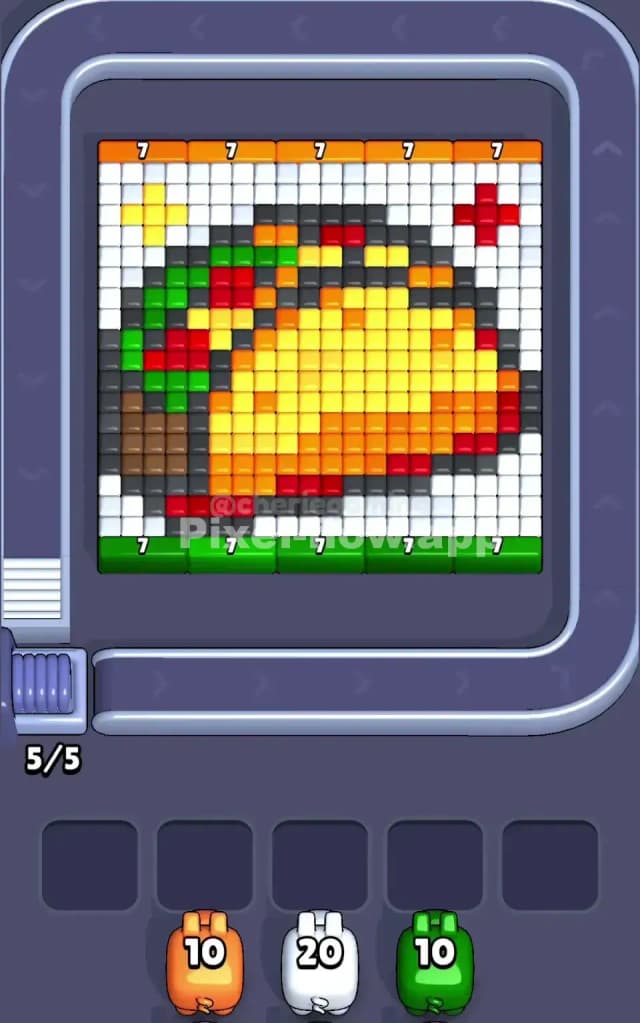
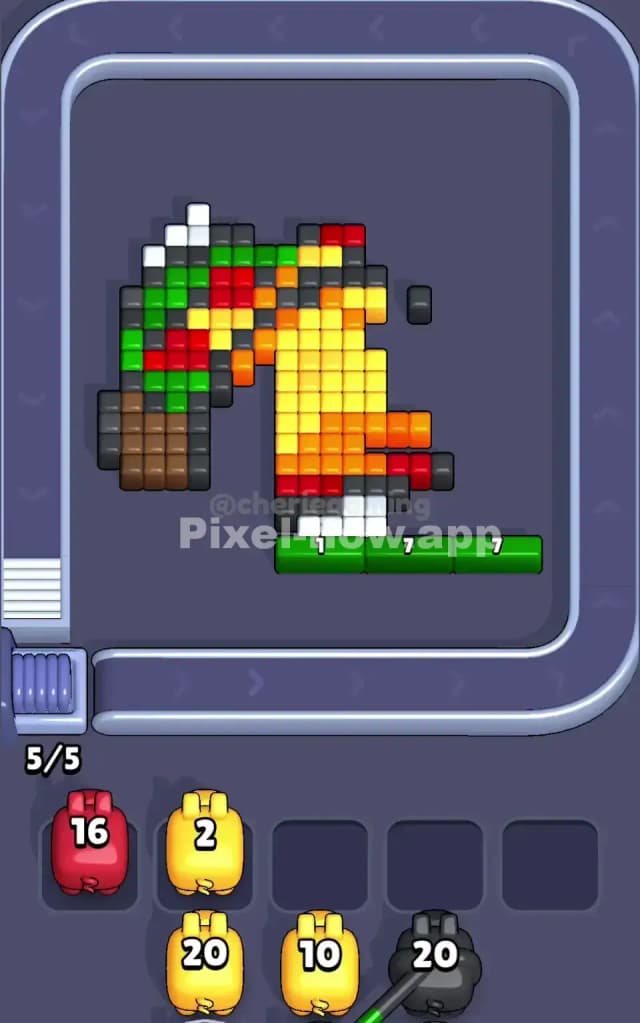
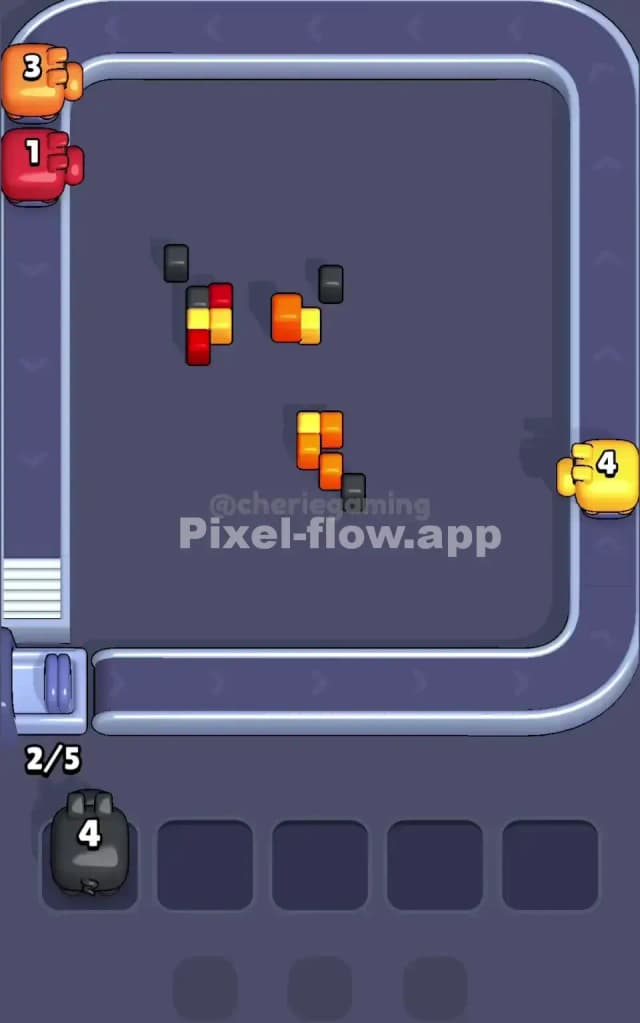
Pixel Flow Level 96 presents you with a vibrant, multi-layered voxel picture dominated by warm tones—primarily yellows, oranges, and reds—arranged around a darker gray core. The overall composition suggests a stylized sun or star-like figure radiating outward, with yellow at the center gradually transitioning to orange and red at the edges. You'll notice the top of the board features a row of orange pigs, each marked with a "7" indicating their ammo count, while the bottom row contains your incoming pig queue: an orange pig with 10 ammo, a white pig with 20 ammo, and a green pig with 10 ammo. White and gray cubes form anchor points and structural elements throughout the puzzle, with green cubes clustered on the left side and red cubes scattered across the right. The layered nature of this design is crucial—you're not just removing cubes at random; you're excavating through distinct color bands to expose what lies beneath.
Win Condition and Deterministic Nature
To clear Pixel Flow Level 96, you must eliminate every single voxel cube on the board. The good news? Every pig's ammo count is fixed, and the order in which pigs arrive from the queue is completely deterministic. That means there's no luck involved—only strategy. You've got exactly 7 ammo pigs coming from the top, plus the three pigs waiting in your queue below, for a total ammunition pool that must precisely match the cube count on the board. This predictability is both a blessing and a curse: it means there's a "correct" sequence that'll solve Pixel Flow Level 96 cleanly, but finding it requires careful planning and patience.
Why Pixel Flow Level 96 Feels So Tricky
The Ammo-to-Cube Bottleneck
The primary challenge in Pixel Flow Level 96 is that the board's color distribution doesn't neatly align with the incoming pig queue. You've got two orange pigs (10 ammo each) waiting at the bottom, but orange cubes are densely packed throughout the middle and right side of the image. If you're not deliberate about when you fire each orange pig, you'll quickly exhaust one pig's ammo on just a portion of the orange cluster, then watch helplessly as the second orange pig arrives to a board with misaligned targets. Suddenly, that pig has nowhere to shoot, and it drops into a waiting slot—wasting precious buffer space. The white pig's 20 ammo is generous, but white cubes are relatively sparse, mostly forming structural borders. If you deploy the white pig too early, you'll spend ammo on cubes that should've been exposed later by other color removals, and you'll again end up with a half-empty pig jamming your queue.
Hidden Color Patches and Layer Exposure
Another sneaky difficulty in Pixel Flow Level 96 is that certain colors are "hidden" behind outer layers. You can't see all the red cubes until you've cleared some of the orange away; you can't access the green efficiently until you've carved into the left side first. This means you'll often face a situation where a pig arrives but most of its color's cubes are obscured. The gray cubes, in particular, form a dark middle layer that's tough to see clearly—you might miscalculate how many gray cubes remain, leading to an unexpected empty pig. Additionally, the yellow cubes at the very center are hemmed in by orange, requiring surgical precision to extract without leaving orange cubes stranded.
The Mental Friction Point
Honestly? I found Pixel Flow Level 96 maddening the first couple of attempts because I kept trying to "do something" with every pig immediately, rather than understanding that sometimes a pig should drop into a waiting slot if its targets aren't exposed yet. The moment it clicked was when I realized: the waiting slots aren't a failure state; they're a parking garage for pigs whose turn hasn't come yet. Once I started planning three pigs ahead instead of reacting to the current one, the level transformed from frustrating to genuinely satisfying.
Step-by-Step Strategy to Clear Pixel Flow Level 96
The Opening: Start With Controlled Orange
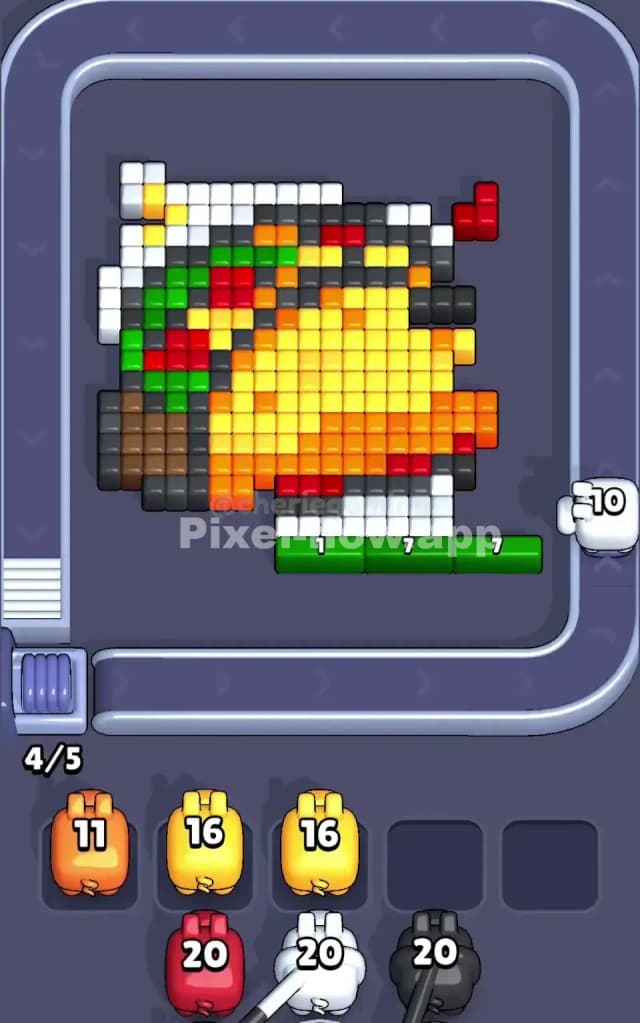
Your first move in Pixel Flow Level 96 should be to fire the orange pig from the top row—one of those pigs marked with "7" ammo. Don't expect to clear all orange cubes immediately; instead, focus on exposing the yellow core. Orange cubes sit on top of the yellows, so breaking through the orange perimeter strategically will reveal what's beneath and set up the white pig for success. Aim for the densest orange patches on the right side and center, firing just enough to create sight lines into the interior. Keep your waiting slots mostly empty at this stage—you want at least three free slots as insurance. The goal is to place one orange pig and watch it consume maybe half its ammo on the most accessible orange targets, then prepare for the white pig's arrival.
Mid-Game: Sequence for Exposure and Layering
Once your first orange pig is firing, the white pig should be next in the queue. Here's where Pixel Flow Level 96's complexity shows: the white pig has 20 ammo and should target white cubes, but white is mostly structural—it's the skeleton of the image. Don't use the white pig to clear all white cubes at once. Instead, use it surgically to remove white blocking pieces that prevent you from accessing inner color layers. This keeps your buffer from jamming and sets up the green pig. The green pig with 10 ammo should tackle the green cluster on the left as soon as it arrives; green is somewhat isolated, so there's less risk of ammo misalignment there. Between these three primary pigs, you'll have carved out enough of the board's exterior that the second orange pig (arriving from the top) can now see and target the remaining orange cubes more directly. By the mid-game phase, your waiting slots should cycle naturally—rarely more than two pigs parked at once—and you're exposing deeper layers (yellows, reds, and hidden grays) for the final push.
End-Game: Clean Finish Without Jamming
The closing moves of Pixel Flow Level 96 are all about rhythm and counting. The remaining top-row orange pigs should mop up residual orange once the inner layers are visible. Yellow is surprisingly dense and will require careful management—you might need to use the second or third orange pig to finish yellow cleanup depending on ammo distribution. Red cubes cluster on the right and bottom; they're fairly accessible once orange is thinned. Gray is the wildcard—it's easy to miscount gray remaining, so keep your eyes on it throughout the level. As you approach the final dozen or so cubes, pause and mentally verify: how many of each color remain, and what pigs are still coming? The perfect Pixel Flow Level 96 clear ends with your final pig firing its final shot, all waiting slots empty, and the board completely cleared. If you're down to a single pig with ammo but three empty slots, you've already won—just wait for the board to resolve.
The Logic Behind This Pixel Flow Level 96 Plan
Exploiting Determinism and Order
The reason this strategy works for Pixel Flow Level 96 is that you're working with the game's deterministic pig queue, not against it. You know exactly how many orange pigs are coming, exactly how much white ammo you'll have, and exactly when the green pig arrives. Instead of treating each pig as a isolated decision, you're architecting a sequence where each pig sets up the next one. The first orange pig doesn't need to finish orange—it just needs to break the seal on the inner layers. The white pig doesn't need to clear all white—it needs to strategically remove blocking pieces. This cascading design prevents you from ever reaching a state where a pig has nowhere useful to shoot, because you've ensured targets are exposed before that pig needs them.
Staying Calm and Counting Two Pigs Ahead
The mental discipline required for Pixel Flow Level 96 is straightforward: before you fire a pig, glance at the next two pigs in the queue and ask yourself, "Will my targets still be here when they arrive?" Count visible cubes of each color—yes, actually count them—and compare to incoming ammo. Watch the waiting slots like a hawk; if you ever exceed three pigs waiting, you've broken the sequence and should restart to find the error. Most importantly, don't panic if a pig drops into a waiting slot; that's often the correct play. Pixel Flow Level 96 rewards patience and planning over hasty clicking, so take a breath, trust your math, and execute the sequence deliberately. Once you've cleared it once, you'll see the elegant design underlying all that color, and you'll appreciate why Pixel Flow Level 96 ranks among the game's most satisfying puzzles.